

Showing posts with label Non Food Processing. Show all posts
Showing posts with label Non Food Processing. Show all posts
How to Turn Corn into Biofuel

The First Discovery of Commercial Potential of Natural Rubber
Charles Marie de La Condamine is credited with introducing samples of rubber to the Académie Royale des Sciences of France in 1736. In 1751, he presented a paper by François Fresneau to the Académie (eventually published in 1755) which described many of the properties of rubber. This has been referred to as the first scientific paper on rubber.
Development of Biogas as Potential of Alternative Energy in Indonesia
 |
| The cycle of Biogas |
About Latex (3)
Pigmenting of Latex
 |
| Commercial latex pigmenting liquid |
About Latex (2)
Compounding of Latex
 |
| Rubber tapper pouring latex into a mould at a plantation |
- stabilizers including surfactants
- vulcanizing agents
- vulcanization accelerators
- antioxidants
- fillers
- viscosity modifiers (thickeners) and
- gel sensitizers
Agroindustry of Fermented Products
FERMENTATION
- Derived from ‘fervere’: boiling appearance of the action of yeast on extracts of fruit/malted grain.
- It is due to the production of CO2 bubbles caused by the anaerobic catabolism of the sugars present in the extract.
- Biochemists = fermentation = generation of energy by catabolism of organic compound
- Industrial microbiologist = fermentation = any process for the production of product by the mass culture of a microorganism (Stanbury & Whitaker, 1984)
- Fermentation = gradual change done by enzymes of microorganism (mold, yeast, bacteria) (Hidayat et al, 2006)
About Chitosan
 |
| Chitosan (other name: poliglusam) |
Chitosan (pronounced /ˈkaɪtɵsæn/) is a linear polysaccharide composed of randomly distributed β-(1-4)-linked D-glucosamine (deacetylated unit) and N-acetyl-D-glucosamine (acetylated unit). It has a number of commercial and possible biomedical uses.
Manufacture and properties
About Saponification
Saponification are chemical processes that produce soap from fatty acid derivatives. Traditionally, saponification involves hydrolysis of esters under basic conditions to form an alcohol and the salt of acarboxylic acid (carboxylates). Saponifiable substances are those that can be converted into soap.[1]
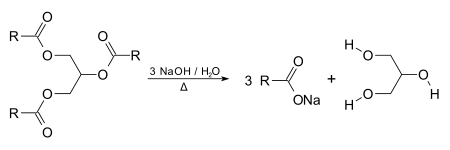 |
| Saponification of a triglyceride with sodium hydroxide. |
About Surfactant
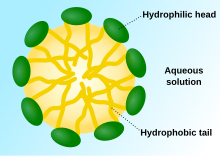 |
| A micelle—the lipophilic tails of the surfactant molecules remain on the inside of the micelle due to unfavourable interactions. The polar "heads" of the micelle, due to favourable interactions with water, form a hydrophilic outer layer that in effect protects the hydrophobic core of the micelle. The compounds that make up a micelle are typically amphiphilic in nature, meaning that not only are micelles soluble in protic solvents such as water but also in aprotic solvents as a reverse micelle. |
Non Food Applications of Palm Oil and Palm Kernel Oil (1)
PAGE 1 OF 3 : NEXT PAGE
The environmental benefits of using vegetable oils, especially palm-based products, are many. They are renewable resources with good environmental characteristics, biodegradable, low ecotoxicity and toxicity to humans, and emit no net CO2 to the atmosphere. When supplies are low, more crops can be planted to make up the shortfall, which would be a boon to agricultural economies. Petroleum, on the other hand, is a finite and depleting resource.
Subscribe to:
Posts (Atom)