

Showing posts with label Fish. Show all posts
Showing posts with label Fish. Show all posts
The Trapezoidal Integration Method for Calculating Fo Values in Fishery Products Canning

Calculating Fo Values in Fishery Products Canning: The improved general method

The Principles of Canning for Fishery Products: Calculating Fo Values
 |
| Thermocouple probe |
The Principles of Canning for Fishery Products: Lethality of Heat During Heating and Cooling
 |
| Clostridium botulinum |
The Principles of Canning for Fishery Products: Bacterial Spores Heat Resistance

It should, furthermore, be an organism which has a characteristic type of growth, or should possess some readily determinable which will serve to differentiate it from contaminants likely to be encountered.
The Principles of Canning for Fishery Products: Selection of Thermal Processing Conditions

The Principles of Canning for Fishery Products Preservation
What is Canning?
Canning is a method of preserving food in which the food is processed and sealed in an airtight container, providing a typical shelf life ranging from 1 year to 5 years and under specific circumstances a freeze dried canned product can last as long as 30 years and can still be safely consumed. The process was first developed as a French military discovery by Nicolas Appert in 1810. The packaging prevents microorganisms from entering and proliferating inside.
 |
| Canned fish |
U.S: Fresh and Frozen Seafood Processing Industry's Revenue for the Year 2009
 Research and Markets: the Fresh and Frozen Seafood Processing Industry's Revenue for the Year 2009 Was Approximately $10.5 Billion Usd, with an Estimated Gross Profit of 33.3%
This latest Fresh and Frozen Seafood Processing Industry report provides the most updated market research on the industry. Its scope contains analysis on the industry's key financial data, competitive landscape, shipment and inventory data, upstream and downstream industries, and trade data.
Oman self-managed in seafoods safety

The Sultanate has implemented stringent measures in tackling threats against safety of seafood and is self-sufficient in the well-being of marine wealth, according to an official at the Directorate of Fisheries. "We have effective system, processes, regulations and action plans besides comprehensive strategy for the safety of seafood taking into consideration that they are meant for public consumption,” Redha Said Khalfan al Faraj, Directorate-General of Fisheries Research, Fisheries Quality Control Centre, and Head of Department of Seafood Safety Implementation System, told the Observer.
Processed Catfish, Working on Added Value for Profits
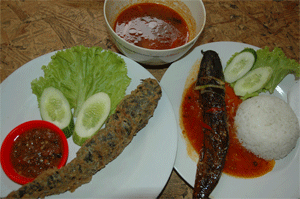 Skimming the stigma of catfish (Lele) as unattractive, minor and not classy.
A variety of creation on processed food of catfish-based makes it certain for catfish to become a promising business commodity. So many creativities and courage to try new different things keeps on rolling. The efforts to adorn the catfish physical appearance, eliminating the impression of creepy, dark, and snake-like appearance, becomes a special challenge. The purpose is to improve attractiveness for the consumers.
Fish Protein Hydrolysates Beat Alternatives for Foods
Fish Protein Hydrolysates Beat Alternatives for Foods | agriculture commodities - commodity prices - food sciences | Protein hydrolysates from Pacific whiting, an abundant and under-utilised fish, produced better foams than bovine serum albumin, says new research from Mexico.
Using the commercial protease Alcalase, researchers from the Centro de Investigacion en Alimentacion y Desarrollo produced hydrolysates from fish muscle that could substitute functional compounds such as bovine serum albumin and sodium caseinate.
Subscribe to:
Posts (Atom)